I have been sitting on this post for awhile. Because I sincerely am not out here trying to cause trouble. But I knew that i would have to respond. So two posts in one day, forgive me. I have to speak to this, because the person that said this to me is not the only one to ‘say’ it. Just maybe not in so many words.
“Please do not start a feud over something as unimportant as politics.” That was what this person said to me. And it hurt my heart, for a couple of reasons.
But I sat with that a while. Turned it over. Tried to receive it the way it was meant — with love, I know. With a desire for peace. I understand that.
But I keep coming back to something I cannot unknot.
They said that too. The Germans. The ordinary ones. The bakers and the teachers and the bank clerks. They told themselves — and each other — that politics was not worth the trouble. Not worth the discomfort. Not worth the family dinner going cold.
Martin Niemöller was a pastor. A pastor. And he said afterward, of those years when everything was shifting and the signs were everywhere: we preferred to keep quiet.
A man named Milton Mayer spent years after the war interviewing ten ordinary German citizens — not monsters, ordinary people — asking how it happened. One of them said this:
“I fooled myself. I had to. Everybody has to. If the good had been twice as good and the bad only half as bad, I still ought to have seen it… But I didn’t want to see it, because I would have then had to think about the consequences of seeing it, what followed from seeing it, what I must do to be decent.”
He didn’t want to see it.
Because seeing it cost something.
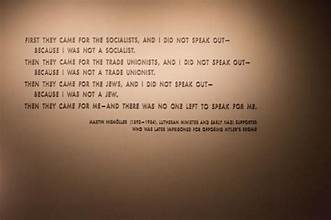
And here is what Niemöller said — the thing that is carved into stone at the Holocaust Museum:
First they came for the socialists, and I did not speak out — because I was not a socialist. Then they came for the trade unionists, and I did not speak out — because I was not a trade unionist. Then they came for the Jews, and I did not speak out — because I was not a Jew. Then they came for me — and there was no one left to speak out.
He was a preacher who kept quiet to keep the peace.
I know what I am called to. I know whose I am. I am not trying to be political. I am trying to be faithful. And faithfulness — the kind that costs nothing, risks nothing, disturbs no one at the table — I’m not sure that’s faithfulness at all.
I don’t want a feud. Lord knows I don’t. I want the table. I want the people at it. I want to grow old with the people I love and argue about whose cornbread recipe is better and watch the grandchildren run.
But I also know that silence has a history. And that history is not kind to those who chose it because the alternative was uncomfortable.
Paul said he determined to know nothing among them except Christ, and Him crucified. I hold onto that. But Christ crucified is not a quiet thing. It is not a safe thing. It is not a thing that left the dinner table undisturbed.
The cross was political. Rome made sure of that.
I am not equating. I am not dramatizing. I am asking — genuinely, with love — what does faithfulness look like when the stakes are real? When the people being affected are not abstractions but neighbors? When the silence of the church is, itself, the wound?
I don’t have a clean ending for this.
I just know I cannot call it unimportant. Not because I want a fight. But because I’ve read what happens when enough people do.
“The fact is, I think, that my friends really didn’t know. They didn’t know because they didn’t want to know.” — Milton Mayer, They Thought They Were Free, 1955
Leave a Reply